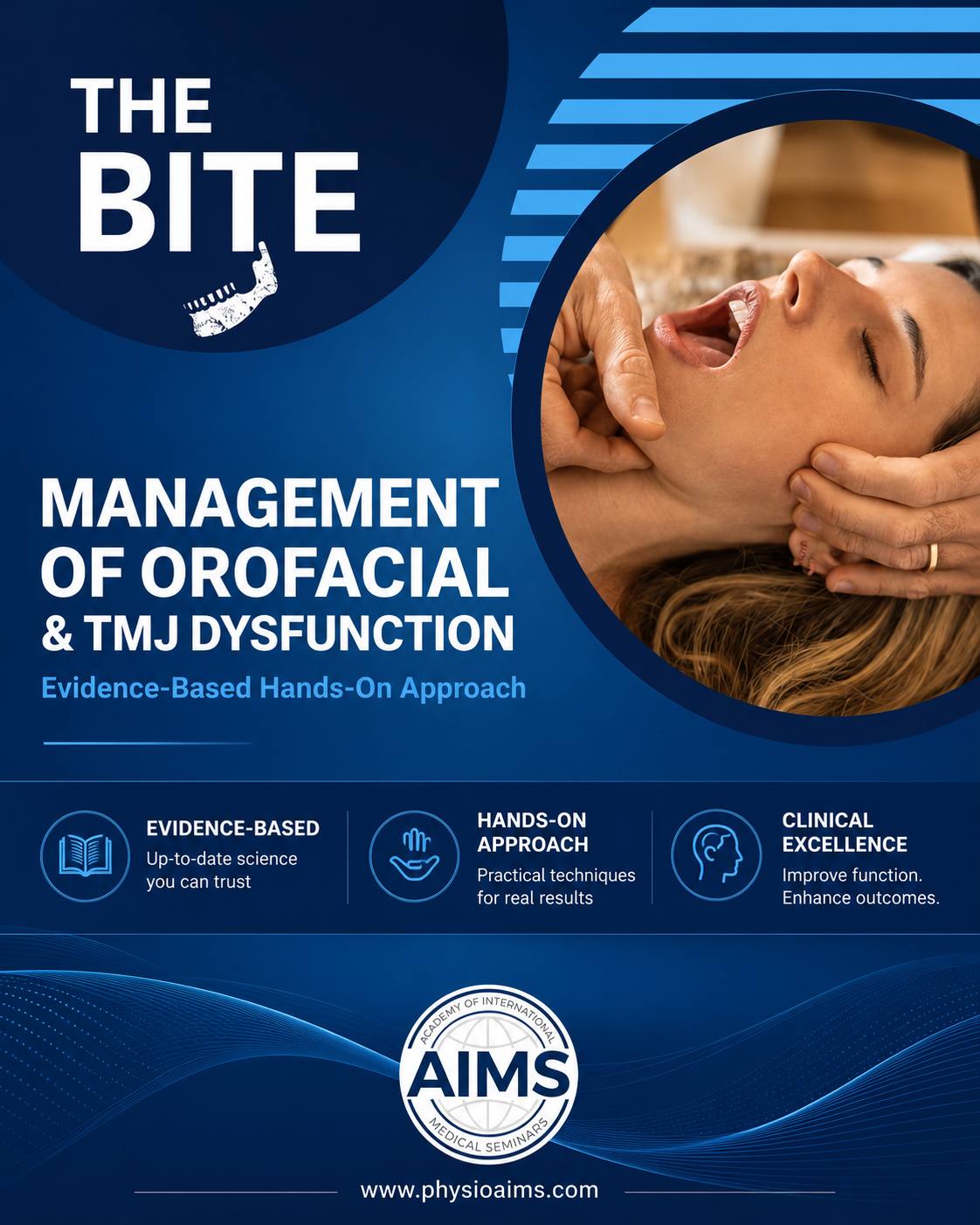
The Bite

5.00 (3 Ratings)
0,01 $
description

The Bite Course (TMJ Management) is a comprehensive clinical course designed to provide physiotherapists with an in depth understanding of temporomandibular joint disorders and their multidisciplinary management. The course integrates anatomical foundations, biomechanics, clinical assessment, and evidence based treatment strategies for orofacial pain and TMJ dysfunction.

The program covers detailed anatomy of the temporomandibular joint, articular disc, masticatory muscles, and their relationship with the cervical spine and posture. Participants will learn the underlying mechanisms of TMJ disorders, including disc displacement, muscle dysfunction, hypermobility, bruxism, and central sensitization.

A strong emphasis is placed on clinical reasoning and hands on assessment skills, including history taking, observation, palpation, range of motion measurement, and differential diagnosis. The course also addresses conservative and advanced treatment approaches such as manual therapy, soft tissue techniques, electrotherapy, therapeutic exercises, and patient education.

By combining theoretical knowledge with practical clinical insights and case studies, this course aims to enhance participants’ ability to accurately assess, manage, and rehabilitate patients with temporomandibular disorders in clinical practice.

objectives

  • By the end of this course, participants will be able to:
  • • Understand the detailed anatomy and biomechanics of the temporomandibular joint
  • • Explain the functional relationship between TMJ, cervical spine, posture, and craniofacial structures
  • • Identify different types of temporomandibular disorders and orofacial pain conditions
  • • Recognize disc displacement disorders with and without reduction
  • • Assess muscle tightness, trigger points, and myofascial pain related to TMJ
  • • Perform comprehensive TMJ assessment including history taking, observation, palpation, and range of motion measurement
  • • Differentiate between deviation and deflection during mandibular movements
  • • Understand the role of central sensitization in chronic TMJ and orofacial pain
  • • Apply evidence based conservative treatment strategies for TMJ disorders
  • • Utilize manual therapy, soft tissue techniques, and therapeutic exercises effectively
  • • Integrate patient education and postural correction into TMJ rehabilitation programs
  • • Improve clinical decision making through case based discussions

Course Curriculum

Course Data

  • Course PDF
Reviews

Student Ratings & Reviews

5.0
Total 3 Ratings
5
3 Ratings
4
0 Ratings
3
0 Ratings
2
0 Ratings
1
0 Ratings
F
3 months ago
.
A
3 months ago
.
.
error: Content is protected !!